Saturday, 24 August 2013

Looking Back

Some blog with a regularity you can set your clock by. Some blog so frequently you wonder when they get time to eat, sleep or do anything worth blogging about. Some bloggers are in both camps. Looking back over nearly three years of this blog — and the two-month gap since my last post — it's clear I am in neither. (That said, this blog has sustained better continuity than one of my technical blogs, which enjoyed a hiatus of almost eight years between one post and the next.)

Although I posted something here last month, it doesn't count as a post written by me — it was a guest post on Calum Kerr's blog tour, where the only writing technique I employed was copy-and-paste. That's not say I didn't blog last month, but what I wrote was posted here rather than here.
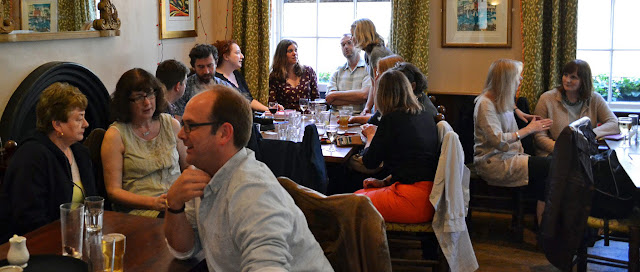

Which is a good place to start. That post — "Shipshape and Bristol Flashing" — describes some of the behind-the-scenes and what-happened-on-the-day for National Flash-Fiction Day 2013 in Bristol. For my own reading slot I opted for four very short flashes — "Another Coffee", "A Higher Calling", "Lost Love's Labours" and "Wrecked" — rather than a single, longer piece. You can see more on the BristolFlash Facebook page.

Coinciding with NFFD was a FlashFlood, which featured my drabble "Trashed", and the results of the British Fantasy Society flash fiction competition, in which a story of mine made the shortlist. Still keeping it short, "Ring Pull", a short rather than a short short story, made the shortlist of the Limnisa–Bluethumbnail Competition.
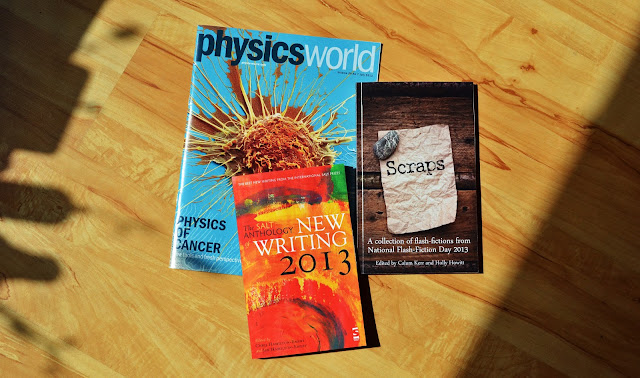

The last couple of months also saw some dead-tree story publication: my Flash 500 shortlisted story "Jack-o'-Lantern" appeared in Scraps, the NFFD anthology; "Alice2007" appeared in Physics World, a commission that grew from a conversation at April's Word of Mouth; and "A Higher Calling" appeared in The Salt Anthology of New Writing 2013. Back online, "Two Weeks in Spain" found a new audience at ReadWave.

Writing-related events are often like buses: nothing for a while, then two or three turn up together. What this usually means in practice is that I usually miss a lot because I'm away... but it's summer, which sees me more at home than away, so I managed to attend two local events this week. First, the launch of BristolCon Fringe, a monthly fixture featuring SF and Fantasy readings from local authors, kicking off with Myfanwy Rodman and Gareth L Powell. Second, I went to the Southville Writers meetup, a relaxed mix of flash readings, conversations about writing and drink.

Next time... will be sooner rather than later. Instead of looking back, I'll be looking ahead.

Friday, 12 July 2013

Guest Post: Under Pressure

It's Friday and there is flash fiction, but it's not from me. For today's thoughts and tale I'm handing the mic over to the blog-touring Calum Kerrauthor of recently published collection Lost Property and director of National Flash-Fiction Day, to channel the early eighties with a rendition of "Under Pressure", cunningly reinterpreted and recast as an allegory on creative writing. Take it away Calum!


Photo by Pey Colborne

In 2005 I gained my PhD in Creative Writing. After that I suffered a period of ‘writer’s block’ which lasted almost eighteen months. After that, I wrote fairly steadily for a couple of years, and then had another nine month period of ‘writer’s block’. That was four years ago and since then I have not suffered.

But also — and this is the reason why the terms have been placed in inverted commas — I have come to the opinion that there is no such thing as ‘writer’s block’, there is just insufficient motivation.

This is potentially a contentious position, but let me continue before you all start shouting and waving your order papers like crazed MPs waking from a post-prandial snooze to discover that your expenses have been outlawed.

I do believe that an individual piece of writing can grind to a halt. I also believe that sometimes, as a writer, you need to flick the switch from ‘transmit’ to ‘receive’ in order to refill the well, to have new things to broadcast, and to mix new metaphors. But, the idea that you can be full of the desire to write, full of ideas, but unable to write, just sits wrong with me now.

I firmly believed in it, back in those periods I mention above. And, I suppose, if it comes along again, I will believe in it again. But, my experience of the last few years will make it hard for me to convince myself of the fact. You see, back in late 2009, I discovered flash-fiction and it drew back the curtain and revealed the true Wizard of Block.

And, before you say that I am just in a particularly productive period or anything, I am currently 80,000 words into writing a novel and approaching its end, but I haven’t done any work on it in 6 months. Am I blocked? No. I’m just busy and insufficiently motivated to finish it (part laziness, part consumed with other work, part terrified of f**king up the ending).

But how, I hear you start to grumble, has flash-fiction convinced me of the myth of block?

Well, as is becoming very well documented, I have undertaken a couple of projects to write flash-fiction on a daily basis. First there was 31, then came flash365. That added up to nearly 400 flashes written in just over a year. How did I do it? Was I insanely inspired? Were aliens beaming stories into my head? Was I churning out rubbish and calling them stories?

Well, the last one is something you would need to judge for yourself, but considering the number of them which have found publication, I think perhaps not. So, how did I do it?

One word: pressure.

The first project, thirty-one stories to be written in January 2011, happened from a casual conversation with my then girlfriend, now wife, Kath. I put it forward as an idea, half joking, but when I woke the next morning a Facebook group had been created so that several dozen of my friends could monitor the project and make sure I was doing the work.

Pressure.

The next time around, I understood the need for the stern gaze of outsiders forcing me on, so I committed to publishing a new story every day on a blog, with a cut-off of midnight. And it worked. I never missed a day. If I was worried that I might, I wrote the stories early and scheduled them. After the first few times that I swerved too close to the deadline and received emails and Facebook messages asking me ‘where the heck is tonight’s story?’ I knew I could never miss.

Pressure.

And then, my promotional activities for National Flash-Fiction Day landed me on radio shows, on both Radio 4 and Radio Solent, being given a sound-effect, a time-limit of twenty minutes and half an hour respectively, and being told to produce a broadcast-worthy story.

Lots of pressure.

And now? Now I have started writing flash-fictions as a performance. I use a projector connected to a computer with a word processor, I take prompts from the audience, put five minutes on the clock, and craft a tiny tale while an audience reads along. It’s terrifying, but it works!

All the pressure!

Add all this together and you can see how my belief in THE BLOCK might have dissolved. You see, there have been times during all of this when I have really not wanted to write. Times when I have been as resistant as a resisting thing. Times when I was sure that I would put my fingers on the keys and nothing would happen. But it always has. Always. All I have needed is the motivation.

And, this is the sad truth of being a writer. Until you reach a certain level of success, where your editor is dribbling down your neck, reading your words as you type the last full stop, then there is no such thing as a deadline except those you create for yourself. Through flash-fiction and my crazy projects, I have discovered a way to build some of these for myself. What would be your way?

So you can see what happens under pressure, here is a story I wrote for the Radio Solent Breakfast Show on National Flash-Fiction Day 2012. I was given the sound effect of a ship’s horn and thirty minutes to write. I managed to produce two stories in just under fifteen minutes. This, the second one, is the one which I then broadcast.


Travelling Hopefully

The foghorn tore the air with a blast which echoed back from the quayside.

Celia had been four years old the last time she had been here. She barely remembered it. Visions of green and grey were all that she had in the way of childhood memories.

But now, here she was again after a lifetime of other countries.

She thought of growing up in Australia, and then the years spent in New Zealand as they travelled for her father’s work.

In New Zealand she met an Italian man and he took her all the way home to meet his family. She stayed in Italy for twenty years.

But when he left her for a local girl who didn’t need to hide her pale skin from the sun and didn’t — still! — need national customs explaining to her, she had set off on her own. Four years working in Belgium and three in France had finally been enough. She had needed something else. She had handed in her notice. She had packed her bags. And she had set sail.

And now, here she was.

The Southampton docks drew closer and closer. They weren’t lined with well-wishers. They weren’t lined at all. But it didn’t matter.

She was here. She was home.


Photo by Kevlin Henney

Calum Kerr is a writer, editor, lecturer and director of National Flash-Fiction Day in the UK. He lives in Southampton with his wife — the writer, Kath Kerr — their son and a menagerie of animals. His new collection of flash-fictions, Lost Property, is now available from Amazon or direct from the publisher, Cinder House.

Friday, 21 June 2013

Flash Fiction: Lost Love's Labours

The love was gone. She searched all the places it had been. In the bedroom, at their favourite restaurants, among the wedding photos... she tried each one in turn, but it was nowhere to be found.

She tried to rekindle old flames, but found no more than ashes. She tried new flames. They burned passionately, brightly and briefly. Lovers loved but were not love.

She found it one morning over breakfast. Time and familiarity had misplaced it. A simple and true "I love you" served with coffee, woven discreetly into the daily routine. So easily overlooked, yet there all along.


"Lost Love's Labours" was first published with The Pygmy Giant. More background here.

Friday, 14 June 2013

Flash Fiction: The Woodcutter's Stepdaughter

"Your hair is the break of day, the beauty of autumn."

These might once have been her mother's words, spoken as she brushed Scarlet's hair each morning. With patience and love she would look into the eyes of her only daughter, her only child, her only family. Gazing at Scarlet she would look into the past. She would talk about Scarlet's Papa, how she missed him, how they were when they were young, so free, so in love.

"Your skin is the falling of snow, but with the warmth of spring."

These were words of love, but not her mother's. That childhood was past. Her mother's kindness was buried in bitterness and time and a marriage to the brawling Bûcheron, a man Scarlet was forced to call Father but could never call Papa.

"Your eyes reflect a summer's sky with a sparkle from the North Star."

These words of love were born of passion, the love of a lover, Benjamin, her dearest B'jou.

"They are like wolves. His kith and kin are low-born forest dwellers, little more than foragers. You should be done with him. The young men of the village are finer and would court you."

These... these were her mother's words, the jealous contradictions of the woodcutter's beaten wife.

"I take it you have seen the 'wolf'."

Her grandmother greeted her at the door, smiling, knowing. Holding out freshly picked flowers, Scarlet blushed. Her late morning visits on market days had become lunchtime visits. Against her mother's will, Scarlet would take the route through the woods to see her Benjamin, to stray from the path with her B'jou, before taking bread and fruit to her grandmother's cottage.

"Why your mother hates him so, calling him such feral names, I do not know. Such strong hands, such a beautiful voice, such lovely big eyes. A kind and gentle man. Not like that drunken, hateful husband of hers. With my son she was carefree and beautiful; together they were such a couple. That Bûcheron brings out the worst in her. He has made her mean and cowering."

That night her grandmother's words fell in anger from Scarlet's lips.

"Spoilt child! This wolf's lechery and your grandmother's doting affection have poisoned you against us!"

Her mother hit Scarlet, hit her and wept, hit her to protect her, hit her to prevent the woodcutter doing the same. He went to grab Scarlet by the hair, he moved to strike her, but looking her in the eye, he spat and left, disappearing into a darker night to drink.

He returned in the morning bringing with him a twofold tale of sorrow. Scarlet collapsed and cried, but through her grief her anger rose, rose and gave her strength to shout at him, to strike him, to tear into his lies with a passion born of love. He did not strike back. He had no need. The story, a story, was around the village. It was said, so they said, that Scarlet's lover, her Benjamin, her dearest B'jou, had slain her grandmother as she slept; that the woodcutter had happened upon the cottage and tracked him down, closing the circle with his axe.


"The Woodcutter's Stepdaughter" was first published with Dr. Hurley's Snake-oil Cure. More background here.

Friday, 7 June 2013

Flash Fiction: The Promise

Bruised and battered, diminished and forgotten, she still had hope.

She huddled with the others in the darkness, some simply neglected, some broken, others twisted beyond recognition. In the underpass of current affairs they mumbled to one another, about their hopes, about who they once were, about who they could have been and about the few — so very few — who had made it. Spotlights would sometimes scan over them, singling each one out of the darkness. Occasionally one of their number would be pulled out and thrust briefly into the media's gaze, before being thrown back into the blind spot of the public eye.

She had been born sparkling and smiling, gleaming and radiant, a beacon of hope, a symbol of change. She was held up and shown to all, paraded along the party line, praised without hesitation, promised without condition. It was all she knew.

But she began to sense there was more. There were those who doubted, those who criticised, those who spoke of others, of other promises made, promises now neglected, broken and twisted. And for the first time she noticed the darkness beyond the media's light. She saw shadows in the shadow beyond the edge of the platform. She saw the others huddled in the darkness, so many, once like her but now less, so much less.

And in the light she found she was no longer alone. There were others, sparkling and smiling, gleaming and radiant, each one paraded and praised and promised as beacons of hope and symbols of change. As each one arrived the platform became crowded. She was no longer at the front, no longer at the centre of everyone's attention, but still she smiled.

Then came the election. They won. They cheered. This was it. They had done it. They had made it. They awaited fulfilment. All those promises. But the light flickered and drifted away. They found themselves in darkness. They found they were not alone. A few — so very few — were pulled into the distant, fickle light. Most were returned, but never as they were before.

Bruised and battered, diminished and forgotten, she still had hope. Another election was coming.

Restlessness and optimism, a desire for change, a desire for continuity, dissatisfaction and confrontation, proposal and counterproposal. She could feel the winds of rhetoric gathering, spinning, husting. A need for promises, new and old, would set the public stage and recall her to it. She would be prepared, dressed up, made over, sent out once again into the limelight, a promise renewed, repackaged and reaffirmed. She would smile and bask as she did when she was first made.

Maybe this time it would be for real. Maybe this time she would make it. Maybe this time.


"The Promise" was first published as part of the second FlashFlood, in promotion of National Flash-Fiction Day. More background here.

Saturday, 1 June 2013

BristolFlash

National Flash-Fiction Day (Saturday 22nd June) is almost upon us. And, as promised some time ago, a couple of things are happening in Bristol, organised together with Tania Hershman, Sarah Hilary, Pauline Masurel and Deborah Rickard. There is a Facebook page for BristolFlash that you may wish to either Like or observe more dispassionately at your leisure, whichever suits you best.

At Bristol Central Library in the afternoon, Tania and Calum Kerr, director of NFFD, will be leading a workshop. Admission is free, but it would be great if you could let us know you're coming either through the Facebook event page or via the corresponding Eventbrite page.


At The Lansdown in the evening, we have gathered an excellent group of writers to read you some of their finest flash. As well as the five organisers and Calum, we also have Anna Britten, Ken Elkes, Dan Holloway, Paul McVeigh, Nick Parker, Jonathan Pinnock and Clare Reddaway reading. Admission is £2 on the door. If you're planning to attend please let us know via either Facebook or Eventbrite.


Hope to see you then!

Friday, 17 May 2013

Flash Fiction: College Fund

"Evie, virginity is precious. It's not something to be given away freely — you can't get it back."

Evie's mother offered today's breakfast homily with burnt toast. There seemed no end to the advice sandwiched into the summer between school and university — morality, money, contraception, cooking, computers.

Her mother struggled as much with their bills as she did with their rattling PC. But sometimes she was right. Evie did need a good laptop. The preloved netbook was powerful enough to run the web-design software she planned to use. Her spreadsheet held promising quarterly forecasts for each coming year. She had no wish to be a pauper to her education, a slave to her loans.

Her virginity? Why hold onto something she didn't want? And if she was going to get rid of it, why not profit from it? As her mother said, it was not something to be given away freely.


"College Fund" was first published with The Pygmy Giant. More background here.